How to Tell if Your Website Is Costing You Enquiries
A business website can look perfectly acceptable while still failing to generate enquiries. Appearance matters, but visitors also need to understand what you provide, trust your business and find an easy way to contact you.
A website should help people find your business, understand what you offer, trust you, and get in touch. If it is slow, unclear, difficult to use, or out of date, it may be putting potential customers off before they ever contact you.
Attracting more visitors will not necessarily produce more enquiries if the website is unclear, slow or difficult to use. Before investing in additional traffic, it is worth checking whether the current website gives visitors enough reason to take the next step.
Here are some of the most common signs that your website could be costing you enquiries.
1. Visitors Cannot Quickly Understand What You Do
When someone lands on your website, they should be able to understand your business within seconds.
If your homepage is vague, cluttered, or focuses too much on style over clarity, visitors may leave before they find the information they need. A good business website should make it obvious:
- What you provide
- Who your services are for
- Which locations you cover
- How to contact you
Your main service and location should normally be visible near the top of the page, particularly when you depend on customers searching for a local provider. If people have to work too hard to figure things out, many simply will not bother.
Clear headings, straightforward wording, and a logical layout can make a big difference.
2. Your Website Is Difficult to Use on Mobile Devices
Customers may discover your business, compare services and make contact entirely from a mobile phone. Your website therefore needs to work properly on smaller screens as well as desktop computers.
If text is too small, buttons are awkward to tap, pages do not fit the screen properly, or forms are frustrating to complete, you are likely losing potential customers.
A responsive website is no longer a nice extra. It is a basic expectation.
Your website should be easy to read, easy to navigate, and easy to use whether someone is on a desktop, tablet, or phone.
Check the complete customer journey on a real phone, including the menu, service pages, contact buttons and enquiry forms.
3. Your Website Is Too Slow to Load
Speed matters more than many businesses realise.
If your website takes too long to load, visitors may leave before they even see your content. Slow loading can also affect how professional and trustworthy your business appears.
There are several common causes of poor speed, including:
- oversized images
- poor hosting
- outdated website software
- too many unnecessary plugins or scripts
You can test individual pages using Google PageSpeed Insights, but the results should be considered alongside the experience of using the website on a normal mobile connection. The homepage is not the only page that matters, so test important service and contact pages as well. https://pagespeed.web.dev/
Optimised images, appropriate hosting and efficient page construction can reduce delays and give visitors a smoother experience from the start.
4. Your Website Is Not Built Around Search Intent
Even an attractive website may struggle to attract visitors if its pages do not match what prospective customers are searching for.
Search optimisation involves more than repeating keywords. Each important page should have a clear subject, useful content, descriptive headings, an appropriate page title and internal links from other relevant parts of the website.
Technical factors such as mobile usability, page performance, image optimisation, indexing settings and canonical URLs also need to be configured correctly.
A properly organised website gives search engines a clearer understanding of your services and gives potential customers more useful information when they arrive.
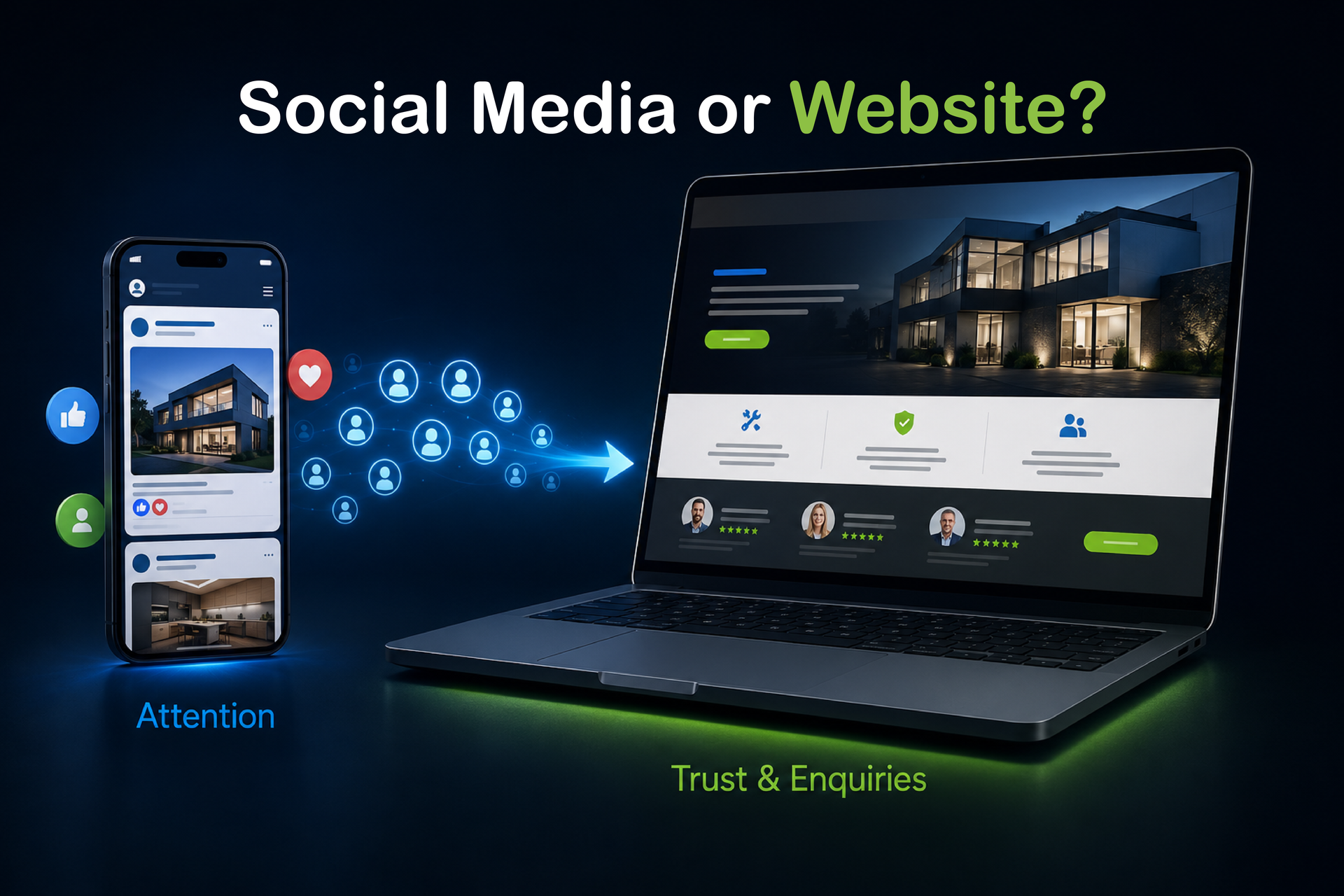
5. Your Website Lacks Strong Trust Signals
Before someone contacts a business, they want reassurance that you are legitimate, professional, and reliable.
If your website lacks trust signals, visitors may leave even if they are interested in your services.
Some of the most important trust signals include:
- A professional and consistent design
- Clear business and contact information
- A secure HTTPS connection
- Genuine testimonials or reviews
- Recent and accurate content
- Consistent branding
- A business domain and matching email address
- Relevant accreditations or partnerships where applicable
- Examples of completed work where appropriate
Only publish testimonials, reviews and project examples when they are genuine and you have permission to use them.
Small details can have a big impact on whether someone feels confident enough to make an enquiry.
6. It Is Difficult for Visitors to Take the Next Step
A website should guide people towards an action.
That could be calling you, filling in a contact form, requesting a quote, or sending an email. If those actions are buried, unclear, or awkward, you may be losing genuine leads.
A good website should make the next step feel simple and obvious.
The most appropriate call to action depends on the page. Someone reading a service page may be ready to request a quotation, while a visitor reading an article may need a link to further information before contacting you.
Use specific wording such as “Request a quotation”, “Book an appointment” or “Contact us about IT support” rather than relying on vague buttons such as “Click here” or “Learn more”.
7. Your Website Content Is Out of Date
Even a well-designed website needs to be reviewed as the business and its customers change
Over time, your business changes. Your services may change, your branding may improve, and customer expectations move on. If your site has not been updated in years, it may no longer reflect the quality of your business.
Outdated websites can also create technical issues, security risks, and broken functionality that damage trust.
Review your services, contact details, opening information, forms and internal links regularly. Technical updates and security maintenance should also be completed where they are required by the website platform.
A Better Website Is About More Than Appearance
Many business owners think website design is mainly about making a site look more modern. In reality, a good website should do much more than that.
It should be:
- clear
- fast
- mobile-friendly
- secure
- easy to manage
- search-friendly
- built to generate enquiries
That is why website design should always be approached as part of a bigger picture, not just as a visual refresh.
A strong website should support your business day to day, help build trust with new visitors, and make it easier for people to choose you over a competitor.
A Quick Website Enquiry Check
Open your website on a mobile phone and try to view it as a new customer. Can you answer the following questions without searching through several pages?
- Is it immediately clear what the business provides?
- Can you identify the locations it serves?
- Are the principal services easy to find?
- Does the information appear current?
- Are there genuine reasons to trust the business?
- Can you find a telephone number or enquiry form quickly?
- Does the form work properly on a mobile phone?
- Is the next step clear?
If several answers are unclear, the website may be creating unnecessary barriers between visitors and your business.
Final Thoughts: Is Your Website Losing Enquiries?
If your website is not bringing in the right kind of enquiries, the issue may not be your business, your pricing, or your services. Quite often, it comes down to the website experience itself. How quickly it loads, how it reads on a mobile, how easy it is to find key information, and whether it feels trustworthy.
A complete rebuild is not always necessary. Improvements to the wording, navigation, page speed, mobile layout and calls to action may help visitors understand the business and contact it more easily.
However, if the underlying design is outdated, difficult to manage or no longer supports your services, replacing the website may be more practical than continuing to repair individual problems.
CED Technology designs responsive, professionally hosted websites for small and medium-sized businesses in Cheshire and across the UK. Each website is planned around the business, its customers and the actions visitors need to take.
If you would like to discuss your existing website or are considering a replacement, contact CED Technology.
Find out more about our
website design and hosting services.
Share this post
RECENT POSTS